
If your website traffic has dropped recently, it’s probably not a technical glitch. Google has quietly changed the rules again, and this time it’s not about keywords or backlinks alone.
It’s about who is creating the content, how useful it actually is, and whether it deserves to rank at all.
Most businesses haven’t caught up yet. That’s where the gap is.
The Shift: Google is Filtering, Not Just Ranking
Earlier, you could “optimize” your way into rankings. Now, Google is filtering out content that feels generic, mass-produced, or written just to rank.
Which means the question is no longer:
“How do I rank this page?”
It’s:
“Does this content actually deserve to be here?”
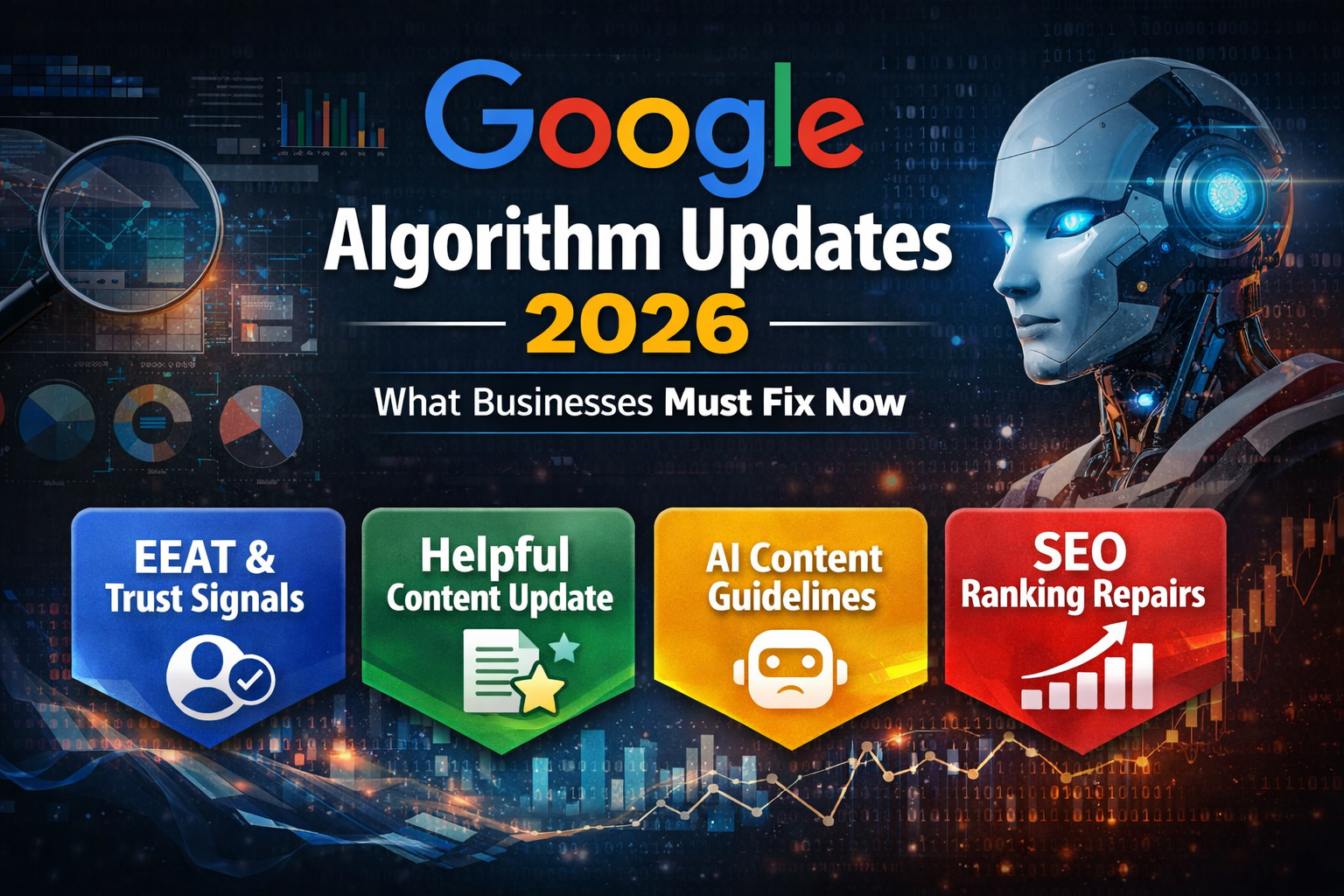
That shift shows up clearly in three areas — EEAT, helpful content, and AI usage.
EEAT: If You Don’t Show Proof, You Don’t Rank
Google wants to know one thing: why should it trust you?
Not your website. Not your keywords. You.
If your blog doesn’t clearly show who wrote it, what experience they have, or why their opinion matters, it’s already at a disadvantage.
This is where most service-based businesses fail. They publish decent content, but it feels anonymous. No author. No real examples. No proof.
A simple shift changes everything.
Instead of explaining concepts like a textbook, start bringing in real perspective. Talk about what you’ve actually seen working. Add small but specific insights that only someone in your field would know.
Even something as basic as a visible author section with a short, credible bio can improve trust signals.
Because right now, Google is ranking credibility, not just content.
Helpful Content: Stop Writing for Search, Start Solving Something
There’s a reason many blogs don’t perform even when they’re “SEO optimized.” They don’t actually help.
Google’s Helpful Content system is designed to catch exactly that.
If someone lands on your page and doesn’t find a clear answer, or worse, has to go back and search again, your rankings will drop over time. It’s that simple.
The fix isn’t complicated, but it requires a mindset shift.
Before writing anything, be brutally clear about the problem you’re solving. Not the topic, the problem.
“Digital marketing trends” is a topic.
“How to reduce cost per lead” is a problem.
One gets traffic (maybe). The other gets engagement, saves, and conversions.
Also, stop over-explaining obvious things. Your audience already knows the basics. What they want is clarity, direction, and something they can actually use.
If your content doesn’t move them forward, it won’t move up in rankings either.
AI Content: The Shortcut That’s Killing Rankings
AI didn’t break SEO. Lazy usage of AI did.
Google has clearly said AI-generated content is fine. But what it’s penalizing is content that feels mass-produced, repetitive, and empty.
And let’s be honest, most AI content today fits that description.
If you’re generating blogs and publishing them without adding any real thinking, you’re creating content that looks fine on the surface but has zero depth.
That’s exactly the kind of content Google is filtering out.
The smarter approach is to treat AI as a starting point, not the final output.
Use it to structure ideas, speed up drafts, or explore angles. But the final version should carry your voice, your understanding, and your experience.
Because that’s the only thing AI can’t replicate well yet.
Authority: One Blog Won’t Build It Anymore
Another silent change is how Google evaluates expertise.
It’s no longer about ranking a single page. It’s about how consistently you cover a topic.
If you’re a digital marketing company, one blog on SEO won’t establish authority. But a set of well-connected, in-depth pieces around SEO, paid ads, landing pages, and analytics starts to build a clear signal.
This is where content strategy matters more than content creation.
When your blogs are connected, when they build on each other, and when they guide users deeper into your site, Google starts seeing you as a source, not just a page.
And that’s when rankings become more stable.
So What Should You Actually Fix Right Now?
Not everything. Just the parts that are clearly holding you back.
Start with your existing content. Look at it honestly.
Does it sound like something anyone could write?
Does it actually solve a problem?
Does it show any real expertise?
If the answer is no, updating those pages will give you faster results than publishing new ones.
Then, tighten your content strategy. Focus less on volume and more on depth. Build around topics, not isolated keywords.
And finally, rethink how you’re using AI. If it’s replacing thinking instead of supporting it, it’s doing more harm than good.
Final Thought
Google’s updates aren’t trying to make things harder. They’re trying to make results better.
Which means the businesses that focus on clarity, usefulness, and credibility will win.
And the ones chasing shortcuts will keep starting over.