
Let me start with something that happened to a real marketing team earlier this year.
A B2B SaaS company with 42 websites, stable rankings, and consistent organic traffic sat down to review their Q1 performance. Organic clicks were down 18%. Not shocking. That happens.
But another number stood out.
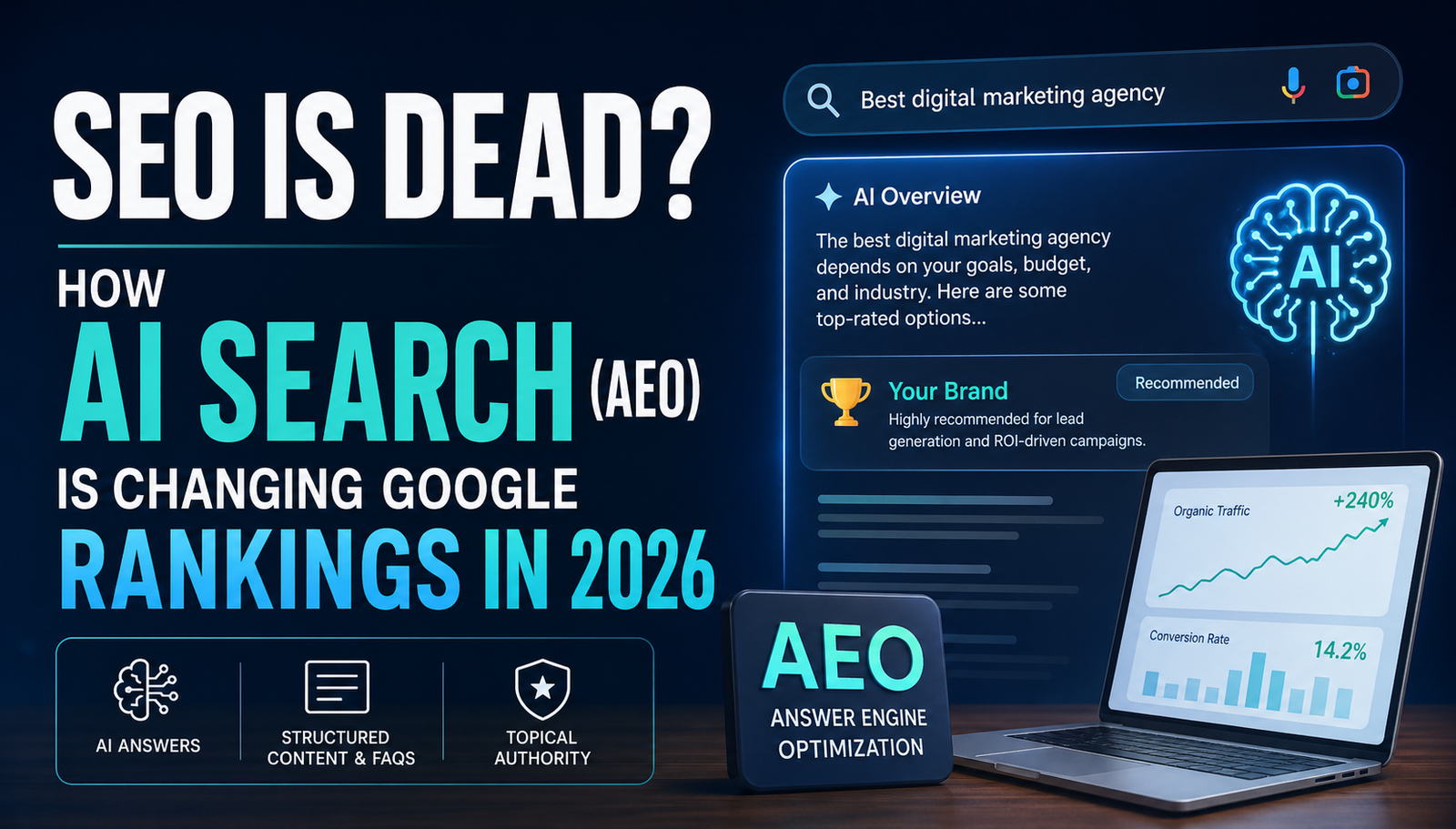
AI-driven sessions were up 240%.
Traffic coming from ChatGPT, Perplexity, and Google AI Overviews — and here’s the part most people miss — those visitors converted at 14.2% compared to just 2.8% from traditional organic search. Same content. Same website. Completely different outcome. The only difference was how users discovered it.
They had unknowingly started structuring content in a way AI could understand and reuse. That story is not unique anymore. It’s becoming the pattern.
So, Is SEO Actually Dead?
No. But the version most businesses are still doing is.
Search hasn’t disappeared. It has shifted in a way most people haven’t fully processed yet. Ahrefs found that when AI Overviews appear, click-through rates drop by more than half. That means even if you rank first, a large portion of users never reach your website.
At the same time, AI tools are growing faster than traditional search, more users are getting answers without clicking, and AI-generated summaries are now appearing in most problem-solving queries. This is not a temporary change or a trend cycle. It’s a structural shift in how discovery works.
You are no longer competing for rankings. You are competing to be selected as the answer.
What Exactly Is AEO?
Answer Engine Optimisation (AEO) is about making your content usable for AI systems. Not just readable, not just optimized, but usable in a way that allows AI to understand it clearly, extract meaningful insights, and confidently include it in a generated response.
Earlier, success looked like this: your page ranks on Google.
Now, success looks like this: your brand is mentioned when someone asks a question inside an AI tool.
That difference changes how content needs to be written, structured, and distributed.
Why AEO Matters More Than Most Businesses Realize
To understand this properly, you need to look at user behavior rather than just algorithms.
When someone clicks a Google result, they are still evaluating options. They are comparing, scanning, and deciding whether to trust what they see.
But when someone clicks through from an AI-generated answer, the decision is already partially made. The content has already been summarized, filtered, and presented as credible. The user arrives with context and intent.
That is why AI-driven visitors convert better. They don’t come to explore. They come to decide.
What AEO Looks Like When It Works
HubSpot realized that their brand wasn’t consistently appearing in AI-generated answers for CRM-related queries. The issue wasn’t lack of content. It was how that content was structured. Their pages were informative, but not easily extractable.
They shifted their approach by rewriting content to directly answer questions, making insights easier to lift, and expanding their presence across platforms where AI tools source information. Within months, their visibility across AI systems increased significantly, and the leads coming from those channels converted at a much higher rate.
Apollo.io faced a different problem. AI tools were describing their product incorrectly, not because their website was wrong, but because outdated Reddit discussions were shaping how AI understood their brand.
Instead of rebuilding their website, they corrected the narrative where it mattered. They updated discussions, influenced conversations, and ensured accurate information existed in places AI systems trusted. Within weeks, the way AI described their product changed.
That is AEO in practice. It is not limited to your website. It is shaped by your entire digital presence.
The Three Pillars That Actually Drive AEO
Most people overcomplicate this. The foundation is simple, but execution is where the real difference lies.
1. Write for Questions People Actually Ask
Search behavior has evolved. Queries are no longer short phrases but complete, contextual questions. Instead of typing “best CRM software,” users now ask, “Which CRM is best for small businesses with limited budget?”
If your content does not reflect that level of clarity, it will not be used.
Generic content sounds like marketing: “Our CRM solution is scalable and efficient.”
Effective content sounds like experience: “For small businesses with under 20 employees, CRM tools like HubSpot or Zoho usually work best because they balance cost and automation. Most teams outgrow spreadsheets within 3 to 6 months once lead volume increases.”
AI consistently favors the second because it is specific and grounded.
2. Structure Content So It Can Be Extracted
Even strong insights lose value if they are buried. AI systems scan and extract, not read linearly like humans.
Content becomes usable when it is structured clearly, answers are placed early, and explanations are simple enough to be lifted directly. When your content can be quoted without needing interpretation, it becomes far more valuable in AI search.
3. Build Authority Across a Topic, Not Just One Page
A single blog post does not establish credibility anymore. AI evaluates your overall presence across a topic.
If you cover SEO from multiple angles — including AI SEO, local SEO, technical SEO, case studies, and practical mistakes — your brand becomes a source rather than just another contributor.
That is what gets remembered and reused.
AEO Is Not Just About Your Website
AI systems do not rely only on your website. They learn from Reddit discussions, LinkedIn posts, YouTube content, reviews, and third-party mentions.
This means your brand perception is influenced by content beyond your direct control. A single outdated discussion can shape how your brand is described more than your own website.
If those external signals are weak or inaccurate, your AEO performance will suffer regardless of how strong your internal content is.
What Most Businesses Get Wrong
The biggest mistake is assuming more content leads to better results. This results in generic blogs, repeated ideas, and outsourced content that adds no real value.
The issue is not volume. It is lack of insight.
AI systems are built to filter repetition. If your content does not add anything new or useful, it will not be selected.
What Actually Works Now
Content that reflects real experience performs best. It answers specific questions and removes uncertainty.
Instead of saying “Digital marketing takes time to show results,” effective content explains the process clearly: “In most campaigns, the first 30 days are focused on testing audiences and creatives. Consistent lead flow typically starts after 60 to 90 days once performance data stabilizes.”
This level of clarity is what makes content usable.
The Bigger Opportunity Most Businesses Are Igning
Large companies often produce polished but generic content. Smaller businesses and agencies have an advantage because they work directly with real scenarios.
When that experience is translated into content, it naturally becomes more useful. Insights based on actual work are difficult to replicate through generic writing.
That is the type of content AI systems prioritize.
The Reality You Need to Accept
This shift is already happening. Some businesses are being consistently recommended by AI systems, while others are gradually losing visibility without understanding why.
The gap between these two groups is increasing.
Final Thought
SEO is not dead, but the simplified version of it is.
You cannot rely on visibility alone. Being present in search results does not guarantee traffic or attention.
What matters now is whether your content is clear, useful, and credible enough to be selected.
Because in 2026, the real competition is not rankings. It is recommendation.
Start Here
Open ChatGPT and search:
“Who are the top [your category] companies in your market?”
If your brand does not appear, that is your baseline. And also your opportunity.